
Opening Briefs

Nuggets from the School Community

Sparkling Job Placement News

Ten months after graduation, 99% of the J.D. class of 2024 was employed — a UC Berkeley Law record since it began tabulating such data.

The school also ranked seventh among United States law schools for sending the highest percentage of 2024 J.D. graduates into associate jobs at America’s largest 500 law firms (58%).

Other notable job placement figures from the class are listed below.

64%
Started their careers at law firms, almost 90% of them in BigLaw
22%
Started their careers in public interest or public sector jobs
20%
Secured judicial clerkships for the 2024 term or future terms
25
U.S. states, districts, and territories where 2024 grads will be clerking
#1
Rank last year for most California Attorney General Honors Program placements
#2
Rank last year for most Skadden Fellowships
#3
Rank last year for most Equal Justice Works Fellowships
64%
Started their careers at law firms, almost 90% of them in BigLaw
22%
Started their careers in public interest or public sector jobs
20%
Secured judicial clerkships for the 2024 term or future terms
25
U.S. states, districts, and territories where 2024 grads will be clerking
#1
Rank last year for most California Attorney General Honors Program placements
#2
Rank last year for most Skadden Fellowships
#3
Rank last year for most Equal Justice Works Fellowships
A man with a shaved head and a dark suit stands behind a podium, speaking into a microphone. A laptop is on the podium, and a bottle sits next to it. To the right is a large, dark screen. The man is holding the microphone and smiling as he addresses an audience, whose heads are visible in the foreground.
INFO SESSION: Assistant Dean of Career Development Eric Stern answers questions from students during a program last spring. Photo by Brittany Hosea-Small
“This abundant good news is a credit to our talented graduates and our dedicated Career Development Office.”
— Dean Erwin Chemerinsky
Three circular portraits of people against a yellow, orange, and blue background. The person on the left is a woman in a yellow-toned circle. In the middle is a man with glasses in an orange-toned circle. On the right is a man with glasses in a blue-toned circle.
TALENTED CREW: (From left) Senior Fellows Doha Mekki, Sam Levine, and Seth Frotman bolster the thriving Berkeley Center for Consumer Law & Economic Justice. Photos by Elliott Ward

Top Trio Joins Our Consumer Team

Three former high-ranking members of the Biden Administration’s antitrust, consumer protection, and public economic law teams recently joined our Center for Consumer Law & Economic Justice as senior fellows.

“Seth Frotman, Sam Levine, and Doha Mekki are among this nation’s leading thinkers on issues of economic justice,” says Ted Mermin ’96, the center’s executive director.

The first of its kind at a top law school, the center helps guide consumer rights advocates nationwide, working to ensure open access to a marketplace free of corporate abuses, fraud, and predatory practices while fostering innovative scholarship, resonant courses, and a growing national community.

Levine directed the Federal Trade Commission’s Bureau of Consumer Protection, overseeing its litigation, rulemaking, and market monitoring initiatives across a wide range of industries. During his tenure, the bureau filed over 150 lawsuits, cracked down on junk fees and subscription traps, secured innovative safeguards for consumer data, and advanced new protections for workers and small businesses.

Frotman was general counsel and senior adviser to the Consumer Financial Protection Bureau’s director, overseeing litigation, administrative law, ethics, labor and employment, and congressional oversight. He launched groundbreaking initiatives on junk fees, medical debt, worker surveillance, and the stampede of Big Tech into consumer finance.

Mekki held the top roles in the U.S. Department of Justice’s Antitrust Division, which filed more monopolization cases than it had in nearly four decades. She oversaw the investigation and litigation of landmark cases to stop criminal cartels, illegal mergers, and anticompetitive corporate practices across U.S. economic sectors.

“Consumer protection is at a crossroads,” Levine says. “It is urgent that we advance bold reforms, defend hard-won gains, and invest in the next generation of advocates.” — Gwyneth K. Shaw

A group of people in a conference room clap and smile. In the foreground, a woman with gray hair wearing a green shirt stands with a piece of paper in her hand. A woman in a pink shirt next to her smiles and claps.
STANDING O: Colleagues cheer the announcement of Sue Schechter’s national award. Photo by AALS

Ahead of the Field

Field Placement Program Director Sue Schechter, also faculty co-director of the law school’s Pro Bono Program, won the 2025 Association of American Law Schools Clinical Section’s inaugural Impact on the Externship Field Award.

Dedicated to providing UC Berkeley Law students with valuable experience through both domestic and international placements, Schechter is a leading national voice on best practices in experiential legal education.

Her nomination included powerful testimonials from clinicians, students, and field supervisors hailing her “magical way of working with students” and “epic” commitment to their pro bono endeavors. The award ceremony featured an inspiring video about her impact.

“Sue Schechter is the most important person across the externships community,” says Nira Geevargis, clinical professor and director of externship programs at UC Law San Francisco. “She’s the glue that holds us together.” — Andrew Cohen

Leading the Way for LL.M. Students

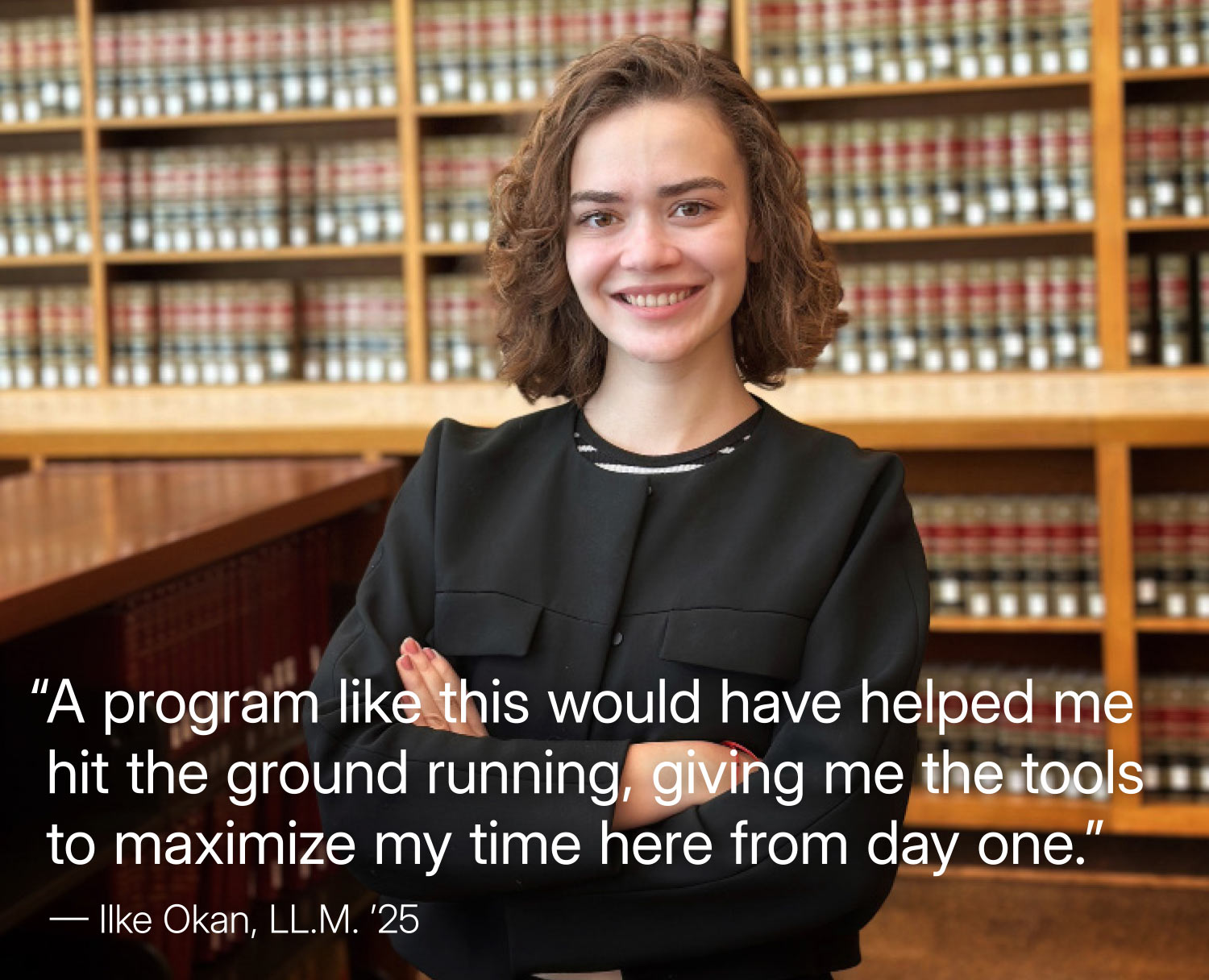
A young woman with shoulder-length brown hair and a black blazer stands in a library. She is smiling directly at the camera with her arms crossed. Behind her are rows of legal books on shelves; quote by Ilke Okan, LL.M. ’25: "A program like this would have helped me hit the ground running, giving me the tools to maximize my time here from day one."
In July, the law school launched the LL.M. Success Academy, an innovative online initiative to prepare international lawyers for success in American LL.M. programs. It offers a unique chance to build essential academic and professional skills while gaining insights from renowned UC Berkeley Law faculty.

Open to students who are planning to attend any American LL.M. program, the academy combines self-paced modules with live virtual office hours to help participants excel from day one of their studies.

“Having taught LL.M. students for many years, I realize that many come to the United States without basic knowledge of American law and law schools,” Dean Erwin Chemerinsky says. “This program is designed to help prepare LL.M. students to thrive in their programs.”

Participants must complete five modules to earn a certificate: Fundamentals of Success in U.S. Law Schools, Legal Research and Writing Fundamentals, Using Generative AI in Law School, Oral Communication and Public Speaking Fundamentals, and Professional Networking Fundamentals. There are also optional modules for Legal English Fundamentals, Bar Subject Fundamentals (Evidence, Property, Civil Procedure), and Corporate Finance Fundamentals.

Each module contains pre-recorded presentations by top educators, and the office hours give opportunities to ask questions and interact with peers. Incoming LL.M. students can finish the course in one month with just a few hours of work per week, not including optional modules, and access all course material for one year from the program launch date.

Discounts are also available to incoming LL.M. students at UC Berkeley, UCLA, UC Davis, UC Law San Francisco, and UC Irvine, as well as government and nonprofit attorneys. — Andrew Cohen

Expert Adviser

Professor Steven Davidoff Solomon has been retained by the U.S. Department of Justice as an expert legal adviser to its Task Force to Combat Antisemitism. He will advise on university corporate governance, settlement agreements with universities, and Title VI and VII university litigation.

In this role, he will contribute his legal expertise to inform policy discussions, and provide input on key issues such as enforcement of Title VI matters and reforming university governance, helping advance the task force’s work fighting antisemitism within higher education and advancing civil rights. Solomon teaches a course on Antisemitism and the Law at the university.

A man in a red sweater stands in front of a whiteboard, gesturing with both hands. On the whiteboard is a hand-drawn diagram with various lines and shapes. A laptop and a can of soda are on a wooden podium in front of him.
PROVIDING GUIDANCE: Professor Steven Davidoff Solomon will advise the U.S. Department of Justice’s Task Force to Combat Antisemitism. Photo by Brittany Hosea-Small
Two young women stand together, holding up handmade paper owls. The woman on the left has her hair in a braid and smiles subtly. The woman on the right wears glasses and a navy t-shirt with a bear on it, smiling broadly and holding up a pink owl with a heart on its chest.
CRAFTY: 3L Julia Saxby (left) and Liz Mooring ’25, recent co-leaders of UC Berkeley Law’s Older Wiser Law Students group, enjoy a Valentine’s Day gathering. Photo by Laurie Frasier

Students Giving a Hoot

With age comes wisdom — and, at UC Berkeley Law, community.

The school’s Older Wiser Law Students (OWLS) group, which brings together students across a broad range of pre-law school experiences, has become a welcome social hub. Events range from exam period coffee breaks and happy hours to picnic meetups and career panels featuring OWLS alumni.

3L Meg O’Neill, who was 29 when she started law school, jokes that OWLS events are “a great opportunity to socialize with others who remember the turn of the century.”

“It definitely has enhanced my experience,” she adds, noting that only about 5% of UC Berkeley Law students are over 30. “Just like any other affinity group, it is important to have spaces where you’re not the odd one out.”

3L Julia Saxby, “30 going on 31” when she began law school, was nervous about leaving an established career, moving to a new state, and how she’d relate to peers as an older student.

When she learned about OWLS while applying to law school, “It really did ease my mind,” she says. “It was a factor in my ultimately choosing to attend Berkeley — not all law schools offer an affinity group for older students.”

Saxby says the group brings diverse lived experiences from people who come to law school at various points in their lives for various reasons.

“But we can all get together and commiserate about back pain,” she jokes. “The group is very much about coming together to have a good time without any pressure or time commitment, which I appreciate so much given how oversubscribed we all are.” — Gwyneth K. Shaw

A dark blue background with the words "It’s The Law" in large yellow script. Underneath, a thin yellow line separates the phrase "with Dean Erwin Chemerinsky" in smaller yellow text.

Clarifying Core Legal Issues

Every day, it seems, a new slate of law-related questions arises. UC Berkeley Law Dean Erwin Chemerinsky, twice named the most influential person in U.S. legal education by National Jurist, is providing answers in “It’s the Law,” a new short-form video series where he concisely breaks down vital legal issues in roughly 90-second clips.

Some of the topics have included whether presidents can declare a national emergency without limits, annex territory, or shut down a federal agency, whether the government can cut funding to sanctuary cities or bar schools from admitting international students, and whether executive orders targeting specific groups withstand constitutional scrutiny.

Available on UC Berkeley Law’s Instagram, TikTok, and YouTube channels, the series has received widespread praise for its clear, measured explanations of today’s important legal questions.

A man wearing a hard hat, safety glasses, and a reflective yellow vest works on a suspended ceiling. He is looking up, holding a tool in his gloved hands, and appears to be measuring or adjusting the metal framing. A yellow step ladder is visible to his right.
SUPPORTING ROLE: The center’s report is a key guide for worker protection advocates.

Roadmap for Making Fair Employment Work

Our Center for Law and Work published a major study — “The DNA of Worker Rights: Key Building Blocks of California’s Model Framework of Wage and Hour Standards” — which examines the rights, responsibilities, and enforcement of California wage and hour law.

Written by the center’s Director Christina Chung with financial support from the James Irvine Foundation, the report shows how California is a model for other states seeking to address poverty among the working poor. A valuable resource for lawyers and policymakers, it also proposes ways to strengthen California law in this area.

A woman with long blonde hair and a graduation cap and gown stands at a podium, speaking into a microphone. She is holding her hands together and smiling. The background is a large outdoor structure with banners in multiple colors.
A young woman with long, dark hair, wearing a black academic robe and hood, stands at a wooden podium. She is smiling and gesturing with her hands as she speaks into a microphone. The background includes parts of a building and colorful banners.
A man with dark hair, sunglasses, and a suit with an academic robe stands at a podium, smiling. He is holding the podium with his left hand as he looks out at an audience. A microphone is positioned in front of him.
A bald man in a black academic robe stands at a podium, mid-speech. He is smiling and gesturing with his right hand as he speaks into a microphone. The background is blurred with hints of colorful banners.
Photos by Brittany Hosea-Small

Commencement Celebration

UC Berkeley Law graduates basked in the glow of a perfect May morning — and their notable achievement — during a memorable, sun-splashed commencement ceremony.

Those addressing the crowd included (clockwise from top left) Professor Kristin Holmquist, J.D. speaker Kaesha Marie Freyaldenhoven ’25, former U.S. Congress member and current Texas Senate candidate Colin Allred ’14, and LL.M. speaker Oscar de la Vega Castillo ’25, as well as Dean of Students Annik Hirshen and Dean Erwin Chemerinsky.

A man in a dark blue suit and a light blue shirt stands at a podium, mid-speech. He is gesturing with his hands and looks to be speaking with emphasis. The background includes a large screen with text that is partially visible.
EURO VISION: Guillaume Loriot, the European Commission’s Deputy Director-General for Mergers, shares his insights. Photo by Jim Block

All-Star M&A Guest List

The annual Berkeley Spring Forum on M&A and the Boardroom welcomed a stellar roster of high-profile speakers and panelists in San Francisco. The list included California Attorney General Rob Bonta, Federal Trade Commission Commissioner Melissa Holyoak, Nevada Supreme Court Justice Lidia S. Stiglich, and the last three general counsels of the U.S. Securities and Exchange Commission (SEC).

Presented by our Berkeley Center for Law and Business, the event addressed timely topics such as artificial intelligence and data regulation, European Union antitrust issues, and upcoming SEC priorities.

The center’s 10th annual Berkeley Forum on Corporate Governance, Oct. 28-29 in San Francisco, will explore the transforming legal frameworks surrounding how companies are governed to meet today’s dynamic business landscape.

A woman with short brown hair and a light-colored shawl with a gray zig-zag pattern sits in front of a tree. She is wearing a turquoise beaded necklace and matching earrings, and she is looking directly at the camera with a subtle smile.
THINKING BIG: Merri Lopez-Keifer has ambitious plans for the Center for Indigenous Law & Justice. Photo by Brittany Hosea-Small

A Leading Voice for Tribal Sovereignty

New Center for Indigenous Law & Justice Executive Director Merri Lopez-Keifer is eagerly integrating her legal expertise, community engagement, and strategic planning into the center’s mission of advancing tribal sovereignty and supporting Native nations.

Building on UC Berkeley Law’s growing commitment to Native issues — reflected in its evolving curriculum, fellowship opportunities, and collaborative initiatives — she says, “Our goal is to create a space of true partnership, where tribes not only feel their participation is welcomed but that their sovereignty and right to self-determination are honored and respected.”

Lopez-Keifer led the California Attorney General’s Office of Native American Affairs for five years, is on the UC Office of the President’s Native American Advisory Council, served on the state’s Native American Heritage Commission, and was chief legal counsel for her tribe (the San Luis Rey Band of Mission Indians) for over two decades.

She invited the Navajo Nation Supreme Court to hear oral arguments at the law school and take part in a roundtable discussion Oct. 15-16, so students can engage with esteemed jurists and deepen their understanding of cross-jurisdictional legal issues.

Lopez-Keifer is also developing a speaker series on current issues facing Indian Country and strengthening the law school’s alumni network to enhance career opportunities for students pursuing work with tribes or in federal Indian law.

Professor and Indian law expert Seth Davis, who helped students revive the school’s Native American Law Students Association chapter in 2018, calls her hire “transformative.”

“Merri brings a dynamic vision, drive, and deep experience to the work of the center,” he says. “She’s one of California’s leading experts on law and policy and intergovernmental relations that involve Native nations and impact Native people.” — Andrew Cohen

109
Native nations in California, more than any other state
36
Participants representing more than 20 Native nations who attended a program at Berkeley as part of the Native American Pathway to Law Initiative
18
UC Berkeley Law students the center sent to the Federal Bar Association’s Indian Law Conference this year, 12 more than last year
1Ls & 2Ls
Can receive funding from the Philip Frickey Fellowship if they accept summer employment involving legal advocacy with Native nations or organizations
109
Native nations in California, more than any other state
36
Participants representing more than 20 Native nations who attended a program at Berkeley as part of the Native American Pathway to Law Initiative
18
UC Berkeley Law students the center sent to the Federal Bar Association’s Indian Law Conference this year, 12 more than last year
1Ls & 2Ls
Can receive funding from the Philip Frickey Fellowship if they accept summer employment involving legal advocacy with Native nations or organizations
A group of four people and two dogs stand on a rocky overlook, with a view of a forested valley and a river below. Two people are crouched down in front with the dogs, a golden retriever and a beagle. The other two people stand behind them, smiling.
ON LOCATION: AppalReD Legal Aid attorney Travis Tackett (left) with Kentucky trip members 3L Medora Jones and 2Ls Isabelle Borchardt, Shreya Kareti, and Daniel Hong.

Service Trips a BLAST

Each spring break, students spread out all over the country — from Alaska to Kentucky — for the UC Berkeley Law Alternative Service Trips (BLAST) program. And each year, students who participate call it one of the best parts of their law school experience.

Part of the school’s thriving Pro Bono Program, BLAST builds on long-term relationships with partner organizations that work with the students and the communities that surround them. The mutual investment has paid huge dividends, for students and the people they serve.

This year’s BLAST trips went to Alaska, Atlanta, California’s Central Valley, Hawai’i, Kentucky, Montana, and Tijuana, Mexico.

These trips are funded by the Pro Bono Program to ensure accessibility to all students. Each group is co-led by students, typically a pair but occasionally a trio, who build and maintain relationships with the supervising attorneys they work with as well as handle travel logistics and help foster the relationship between students.

Mackenzie Gettel ’25, who co-led the Alaska trip last year and the Hawai’i trip this year, calls BLAST “one of my favorite experiential learning opportunities in law school.” She says it empowered her to meaningfully engage in Indigenous and environmental advocacy.

3L Medora Jones, who returned to her home state of Kentucky to assist with FEMA appeals after the devastating floods in Appalachia, says the trip “allowed me to reconnect with the reasons I attended law school in the first place.” — Gwyneth K. Shaw

A woman with curly gray hair and glasses stands in a library aisle, holding an open book. She is looking down at the book, which she holds with both hands. Bookshelves filled with books are visible on either side of her.
TURNING THE PAGE: Ramona Collins capped her 20-year UC Berkeley Law Library career with a major award. Photo by Darius Riley

Booking Excellence

UC Berkeley Law’s Ramona Collins received the 2025 Distinguished Librarian Award, which recognizes excellence in librarianship that furthers the university’s teaching and research missions. Presented every other year, the campus award honors someone who has made a major impact on the UC Berkeley community and/or the library profession.

“Not only is Ramona dedicated and smart, she’s kind, funny, and the heart of the library,” says Associate Dean of the Law Library Jessica Whytock.

Collins joined the Law Library in 2001 and ran its access services department before retiring in June. — Andrew Cohen

A woman with curly gray hair and glasses stands in a library aisle, holding an open book. She is looking down at the book, which she holds with both hands. Bookshelves filled with books are visible on either side of her.
TURNING THE PAGE: Ramona Collins capped her 20-year UC Berkeley Law Library career with a major award. Photo by Darius Riley

Booking Excellence

UC Berkeley Law’s Ramona Collins received the 2025 Distinguished Librarian Award, which recognizes excellence in librarianship that furthers the university’s teaching and research missions. Presented every other year, the campus award honors someone who has made a major impact on the UC Berkeley community and/or the library profession.

“Not only is Ramona dedicated and smart, she’s kind, funny, and the heart of the library,” says Associate Dean of the Law Library Jessica Whytock.

Collins joined the Law Library in 2001 and ran its access services department before retiring in June. — Andrew Cohen