

Democracy Under the Microscope
The new Edley Center confronts crucial issues facing America
Launched in August, the Christopher Edley Jr. Center on Law & Democracy aims to probe underlying causes and train students to effectively safeguard our political system. It’s named after Edley, UC Berkeley Law’s dean from 2004 to 2013, who served in major White House positions under two administrations and worked extensively to improve government and democracy.
The center’s debut program leading up to the election — a five-part speaker series on American democracy and its intersection with the press and social media, elections and the courts, presidential power, and judicial power — drew packed crowds.
“We wanted to provide a forum for serious thinking about democracy and its future at a time when democracy has felt more precarious than it has in many decades past,” says Professor Jonathan S. Gould, the center’s co-faculty director with Professor Daniel A. Farber.
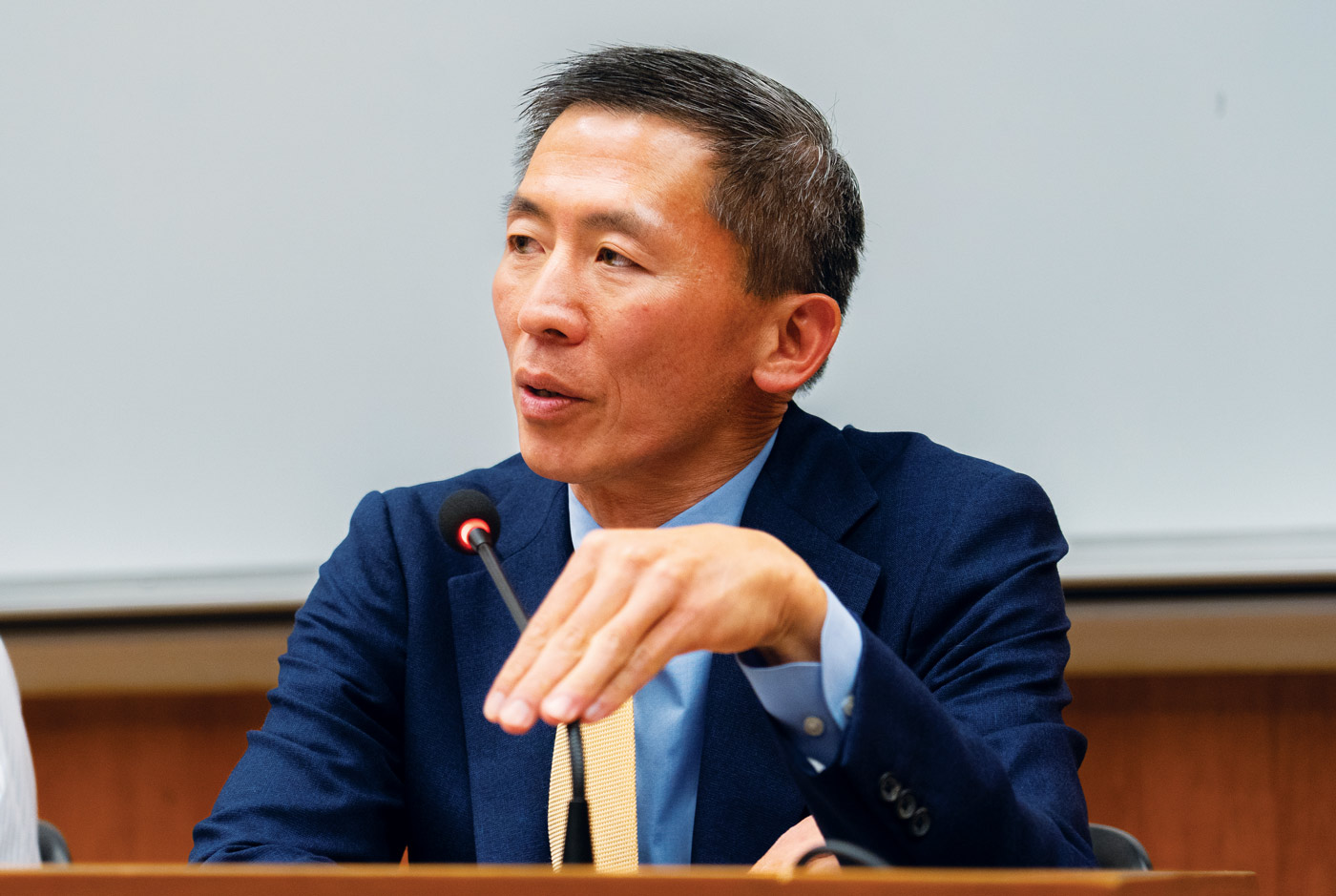
The fifth event featured Chemerinsky and California Supreme Court Justice Goodwin Liu discussing the role of federal courts — particularly the U.S. Supreme Court — in protecting democracy. With longer life expectancies, Supreme Court nominees joining the Court at younger ages, and justices increasingly making “values-based decisions,” their appointments loom more impactful than ever.
A former UC Berkeley Law professor, Liu highlighted a rise in judicial intervention over the past two decades as originalism gains traction as a form of constitutional interpretation, predicting the court’s direction will make centrist judges an antiquated presence.
“For the time being, it’s unlikely that there will be more Stephen Breyers, Anthony Kennedys, Sandra Day O’Connors, or Merrick Garlands nominated for the Court,” Liu said, citing jurists known for their moderate and institutional tendencies.
At the event on presidential power, Farber and fellow Berkeley Law professors Sharon Jacobs and John Yoo discussed the executive branch’s growing role in shaping policy and federal agencies.
Yoo said using criminal prosecution to drive President Donald Trump out of the election failed and will likely create a problematic precedent, pointing to South Korea and Brazil as examples of frequent presidential prosecutions causing instability. “I worry it’s going to cause deeper harm to the presidency and our system because I don’t think it’ll be a one-off,” he said.
Jacobs sounded an alarm about waning federal agency authority, citing various executive branch tactics that she said “can be used to tie up agencies in a systematic way … creating a scenario for death by a thousand cuts.”
Farber discussed Congress’ reduced role in creating policy, and a shift “from where the goal was for administrative agencies to carry out their statutory missions to a mindset that agencies should carry out the President’s policies … Concentrating that level of power in one individual, we ought to be uncomfortable with that in a country that prizes the rule of law.”
The center, which will hire an executive director, presented programs after the election that probed critical issues such as immigration, federal workers, climate, and reproductive justice.