



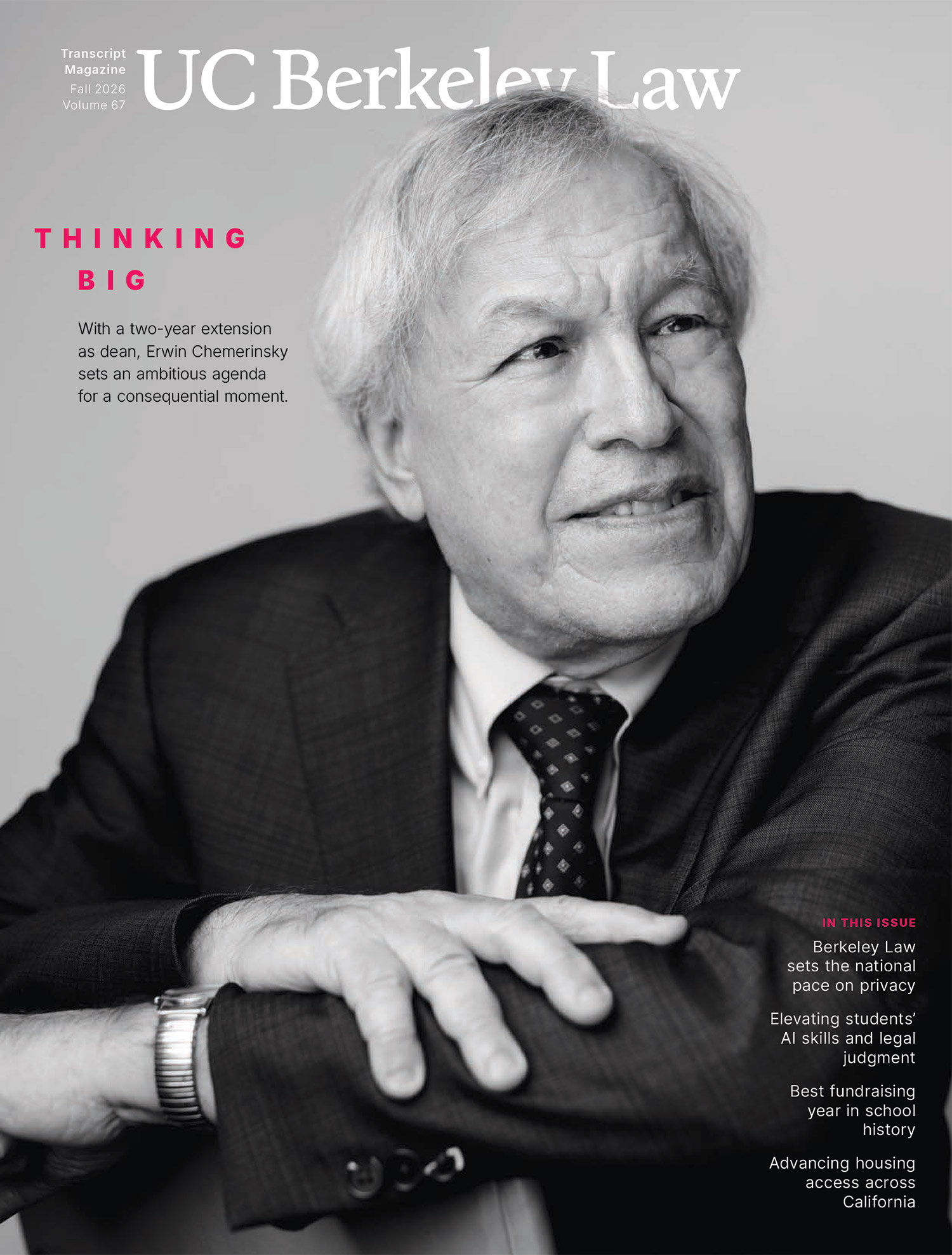
UC Berkeley Law Transcript Magazine Fall 2026

UC Berkeley Law Transcript Magazine Fall 2026 cover
Fall 2026

Table of Contents

Man and woman in professional suits standing outside golden building doors and smiling together.
ALUMNI ALLIANCE: Federal District Court Judge George B. Daniels ’78 shares a light moment with his recent clerk Maripau Paz ’24 outside the Daniel Patrick Moynihan U.S. Courthouse in New York City. Photo by Brittainy Newman

Features

Thinking Big
Faculty, staff, alumni, and students applaud Erwin Chemerinsky’s two-year extension as dean and his enterprising plans moving forward.

Privacy Prowess
As the ways personal information is collected, protected, sold, and stolen permeate our daily lives, Berkeley Law sets the pace in the field.

Photo Essay

Mentorship in Many Forms
Five pairs from different parts of the law school community describe their meaningful connection.

Column

From the Dean
Positioning Berkeley Law to enrich its excellence and make an important impact.

Sections

Opening Briefs
Nuggets from the School Community

Forefront
Leadership in Research, Service & Education

Fast Forward
Student Initiative in Motion

Study Hall
Faculty Honors & Scholarship

Advancement
Updates from Development & Alumni Relations

Class Notes
All in the Alumni Family

UC Berkeley Law logo
Transcript Magazine
Fall 2026, Volume 67

ON THE COVER: Erwin Chemerinsky enthusiastically accepted the university’s request to extend his Berkeley Law deanship by another two years. Cover Photography by Anastasiia Sapon

Assistant Dean, Communications
Alex A.G. Shapiro

Managing Editor & Senior Writer, Communications
Andrew Cohen

Creative Direction
Laurie Frasier

Original Design & Layout
Arnaud Ghelfi, l’atelier starno

Contributing Writers
Maggie Andresen
Gwyneth K. Shaw

Contributing Artist
Sara Singh

Contributing Photographers
Jim Block
Brittany Hosea-Small
Brittainy Newman
Tone Oliver
Darius Riley
Brandon Sanchez
Anastasiia Sapon
Mikie Schulz

Update Your Address
Email: updates@law.berkeley.edu
Phone: 510.642.1832
U.S. Mail: University of California, Berkeley, School of Law
Development & Alumni Relations
224 Law Building
Berkeley, CA 94720-7200

Visit law.berkeley.edu

Instagram & Threads: @berkeleylaw
Facebook: UCBerkeleyLaw
TikTok & Bluesky: @ucberkeleylaw
X: @BerkeleyLaw

Transcript is published by the University of California, Berkeley, School of Law Communications Department.

From the Dean

A portrait photographic headshot of Dean Erwin Chemerinsky smiling and looking to the right
Photo by Philip Pacheco
“… to position Berkeley Law to truly make a difference in legal education, the legal system, and society.”

An Ambitious Agenda

I must confess I am embarrassed that our wonderful Communications Department chose to put a picture of me on the cover and include an article about my upcoming priorities in this issue. Being dean of Berkeley Law is a tremendous privilege and I am deeply honored to have been asked to extend my deanship through June 30, 2029.

There is much that I want to accomplish in the next three years. My top priority is to put the Law School in a good, stable, and secure long-term financial situation. Also, it is essential that Berkeley Law play a crucial role at this unprecedented moment in the history of our democracy.

I want to help support these efforts. I want to use this additional time as dean to encourage us all to think big about what we can do to position Berkeley Law to truly make a difference in legal education, the legal system, and society.

Much of what makes Berkeley Law special is reflected in other articles throughout this Transcript issue.

Many of our faculty members, clinics, centers, and pro bono projects are doing important work to protect privacy. New technology raises a host of unprecedented issues with regard to this important field. As described in a terrific feature spread about our wide-ranging privacy work, there are many efforts — through litigation, through legislation, through regulation, through scholarship, through education — by those in our community to address cutting-edge issues with regard to privacy and the law.

Opening Briefs

Nuggets from the School Community

On-Court Brilliance Fuels Off-Court Support

Berkeley Law may not offer basketball in its robust curriculum, but school was definitely in session during the third annual Order on the Court game.

Extending its undefeated run against Stanford Law student teams, Berkeley’s master class finished with a rousing 70-46 victory spurred by tenacious play, 20 team cheerleaders, and several hundred boisterous fans in attendance.

Basketball player wearing a UC Berkeley Law jersey dribbling past a defender on the court during a game.
HOOP DREAMS: 2L James Steinberger, who led all players with 19 points, plots his next move. Photo by Darius Riley
Basketball player wearing a UC Berkeley Law jersey dribbling past a defender on the court during a game.
HOOP DREAMS: 2L James Steinberger, who led all players with 19 points, plots his next move. Photo by Darius Riley

On-Court Brilliance Fuels Off-Court Support

Berkeley Law may not offer basketball in its robust curriculum, but school was definitely in session during the third annual Order on the Court game.

Extending its undefeated run against Stanford Law student teams, Berkeley’s master class finished with a rousing 70-46 victory spurred by tenacious play, 20 team cheerleaders, and several hundred boisterous fans in attendance.

Group of law students and faculty posing behind the Elmwood Correctional Facility entrance sign.
GROUP EFFORT: Berkeley Law, Stanford Law, and San Jose State undergraduate students join other Record Clearance Project volunteers.

‘A Beautiful Thing to Do’

Instead of taking a respite from their busy schedules, a group of Berkeley Law students spent spring break working on a gratifying Pro Bono Program initiative with San Jose State University undergrads and Stanford Law students to help expunge criminal records through the Record Clearance Project.
Reporter wearing a Press pass having water poured on his face to wash away pepper spray.
TURMOIL: A member of the press rinses his eyes from tear gas deployed by U.S. Customs and Border Protection in an area where it conducted immigration enforcement operations in Minneapolis. Photo by Madison Thorn/Anadolu via Getty Images

Exposing Misuse of Crowd-Control Weapons

A report released by Berkeley Law’s Human Rights Center (HRC) and Physicians for Human Rights found that law enforcement agents misused crowd-control weapons during protests against immigration enforcement operations in 412 verified incidents across 16 American cities between June 2025 and May 2026.
Woman in a black suit demonstrating a yellow hand-held device inside a courtroom before a judge.
COURTING VICTORY: Rebecca Goren ’26 makes a convincing argument en route to winning the Top Gun National Mock Trial Competition in Waco, Texas.

Excellence on Full Display

Berkeley Law students earned several major awards in recent months. The impressive list of honorees includes:

  • Rebecca Goren ’26, who won the Top Gun National Mock Trial Competition and $10,000 first prize. Hosted by Baylor University School of Law, the annual tournament invites the best student advocate from each of the top 16 trial programs.
Forefront

Leadership in Research, Service & Education
Man presenting in front of a chart titled "AI Is Reshaping Legal Work".
WELL VERSED: The course is taught by Berkeley Center for Law & Technology Executive Director Wayne Stacy, who has a background in computer engineering and led the U.S. Patent and Trademark Office’s West Coast branch. Photography by Brandon Sanchez; Illustration by Laurie Frasier

Nuanced AI Training

New course carefully tailors skill development while integrating how best to incorporate human input

As AI increasingly shapes legal practice, a new course is educating Berkeley Law students about the technology’s strengths and weaknesses while giving them more than 100 hours of hands-on training.

Taught by Berkeley Center for Law & Technology Executive Director Wayne Stacy — a former Big Law litigator and U.S. Patent Office leader — AI and the Practice of Law: Public Interest & Private Practice broadens legal skills without lowering the threshold for human judgment and input.

“This is the fundamental question: How are you going to do higher quality legal work with AI than you’re going to do by yourself?” Stacy asks. “It’s not just being faster and cheaper. The jump in the quality of work, in the creativity for your client, is the difference. That’s what I want my students to learn.”

Man speaking during a panel discussion seated at a table with other speakers.
DIVING IN: Then-3L Isaiah Pake (right) was one of several Berkeley Law students to moderate a panel at the Berkeley Journal of Employment and Labor Law’s 50th anniversary symposium. Photo by Laurie Frasier

On the Fast Track

Students revel in Berkeley Law’s rapidly expanding employment and labor landscape

With the AI explosion sparking panic throughout the American workplace, the U.S. wealth gap reaching its widest point in over three decades, and mounting debate over employee misclassification, paid leave laws, and salary range transparency, labor issues have increasingly taken center stage.

At Berkeley Law, growing student interest in them intersects with burgeoning possibilities.

“Labor and employment law at Berkeley is really special due to its scope and accessibility,” says Katie Chin ’26, recent co-editor-in-chief of the Berkeley Journal of Employment and Labor Law. “There are lots of opportunities to take classes on specialized topics and do research on specific areas of interest in collaboration with the Center for Law and Work (CLAW).”

Group of people posing inside the U.S. Capitol Rotunda in front of historic paintings.
INSIDE ACCESS: A group of UCDC Law Program students during a customized tour of the U.S. Capitol Building last semester.

Capital Improvements

Unique UCDC Law Program delivers vital connections, experience, and skills for students

Amid glaringly polarized times in the nation’s capital, the UCDC Law Program provides a rare unifier. Current and past participants alike praise the semester-long program for providing key skills, valuable networks, and crucial career insights.

Iman Eslami ’26 says the experience “deepened my understanding of our system of government” and showed “how many different avenues there are to influence policy and institutional change.”

A collaborative externship program for law students from Berkeley, UCLA, UC Davis, UC Irvine, and UC Law San Francisco, UCDC combines a full-time field work placement with a weekly seminar. This gives students an immersive opportunity to understand how federal statutes, regulations, and policies are made, interpreted, and applied.

Five people smiling in a line indoors behind panel microphones.
NORTHERN EXPOSURE: Alaska Supreme Court Justice Jennifer Henderson (right) visited Berkeley Law last spring for an event on the clerkship process with (from left) recent Director of Judicial Clerkships Anna Han and former state court clerks Ami Shirriff ’24, Elias Garcia ’23, and Amy Reavis ’22. Photo by Rachael Hawk

An Increasingly Powerful Pathway

Alumni are clerking for judges in the supreme courts of five states this fall

Berkeley Law’s newest graduates are clerking for the supreme courts, appellate courts, and superior courts of five states this fall — Alaska, California, Hawaiʻi, New Jersey, and Nevada.

Since graduating, 49 Class of 2025 members have obtained federal and state court clerkships — over 17% of the class according to the school’s Career Development Office (CDO), which supports clerkship applicants before and after graduation. During this past term, 88 alums served as term clerks or permanent staff attorneys for state or federal courts in 22 states and Washington, D.C.

The state court numbers are a point of pride for Assistant Dean of Career Development Eric Stern, who has consistently promoted state-level positions to students interested in clerking.

Three women smiling outdoors in front of a building construction site with scaffolding.
HOUSE CALL: (From left) 3L Olivia Grimes, 3L Meghan Riddlespurger, and 2L Manasa Kumarappan are working to expand housing opportunities while helping to train budding advocates. Photo by Laurie Frasier

Raising The Roof

Student groups work to connect affordable housing production with other core rights

3Ls Olivia Grimes and Meghan Riddlespurger met before law school, when Grimes was working at San Mateo County’s Housing Leadership Council and Riddlespurger at the California Department of Housing & Community Development.

They quickly bonded while pursuing law school and both enrolled at Berkeley Law, where they saw ample outlets for housing work on the tenant and environmental side — but a galvanizing gap in production-side advocacy.

“We created Housers at Berkeley to build an intersectional perspective with all the law students who are passionate about tenants’ rights, economic and environmental justice, and consumer protection,” Grimes says.

Thinking Big

The Berkeley Law community celebrates Dean Erwin Chemerinsky’s unexpected two-year extension, calling him uniquely positioned to elevate the school’s success, chart an ambitious course for its future, secure its long-term financial footing, and help protect the rule of law.
By Andrew Cohen
Photo by Anastasiia Sapon
Some of the adjectives floating around Berkeley Law shortly before Erwin Chemerinsky’s arrival were hardly inspiring: Disjointed. Shaky. Unsettled.
Prior to his appointment in 2017, the school had four deans or acting deans over the previous four years.

“That made it hard to do more than tread water,” says Professor Holly Doremus ’91, recalling the suboptimal atmosphere — and the transformation Chemerinsky quickly set in motion. “One of the most important things Erwin brought is stability. The school has become more cohesive and collaborative, and we have clear momentum in a common mission to be the best public law school in the country.”

Last spring, UC Berkeley extended Chemerinsky’s tenure as dean by two years, through June 30, 2029. He had planned to finish in June 2027 following his second five-year term.

Photo Essay

Mentorship In Many Forms

Talha Syed and Zara Tayebjee ’26

The connection between Syed, a Berkeley Law lecturer, and Tayebjee flowed from an unusually early office-hours visit — before their first Torts class had even met — into a mentorship that reshaped a student’s career ambitions and a professor’s teaching.

Tayebjee’s determination to understand Syed’s approach to law evolved into years of conversations that challenged her to embrace uncertainty rather than seek easy answers. His version of the Socratic method, she says, created space to be wrong, take intellectual risks, and ultimately discover how to ask better questions.

During one disagreement over a case, Syed pointed Tayebjee toward foundational thinkers and encouraged working through the problem herself. That experience redirected her toward legal theory and academic research, a path she’d never envisioned.

Man in a navy suit and woman in a beige suit standing outside near glass architecture.
Photo by Anastasiia Sapon
Group of colleagues in professional attire conversing happily together outdoors at an event.

Privacy Prowess

PRIVACY
PROWESS
FIRST CLASS: Chief Privacy Officer Program leader Jeewon Kim Serrato ’04 (second from right) and Assistant Dean for Strategy, Innovation, and Education Eric Askins (right) talk with members of the first program cohort after their graduation event. Photo by Anastasiia Sapon
As the ways personal information is collected, protected, sold — and stolen — reach into every corner of daily life, Berkeley Law’s faculty, students, and alumni set the pace in the field.
By Gwyneth K. Shaw
W
hen Berkeley Law Professor Paul Schwartz got his start as a privacy law scholar more than 30 years ago, you could assemble most of the field’s experts in a Capitol Hill conference room. Voices and data traveled over physical wires. Vital personal and financial records were consigned to paper. Prying eyes had to be literal.

The rise of the internet changed absolutely everything. The conveniences of the digital world — instant communication over multiple modes, an explosion of media offerings, and a shopping revolution, just to name a few — came with a price. These days, nearly everything that we do leaves virtual breadcrumbs unless we take overt steps to avoid them.

Fast Forward

Student Initiative in Motion
3L Raquel Acosta

Motivated to Innovate

Growing up in an agricultural town north of Chicago — with a family of migrant farmworkers — environmental concerns weren’t something Raquel Acosta had to read about in a textbook.

That drew her to environmental law and environmental justice advocacy, and Berkeley Law offers an ideal path. Acosta leads the Climate Migration & Displacement Project, one of the school’s 40+ Student-Initiated Legal Services Projects, and recently became an environmental justice organizer at the student-run Ecology Law Quarterly. She’s also a co-leader of the Women in Tech Law student organization.

The summer after her 1L year, Acosta interned at the Center on Race, Poverty & the Environment, an environmental justice nonprofit in California’s Central Valley.

PEOPLE FIRST: 3L Raquel Acosta strives to elevate the priorities of those served by her wide-ranging legal work. Photo by Brittany Hosea-Small
Raquel Acosta headshot
PEOPLE FIRST: 3L Raquel Acosta strives to elevate the priorities of those served by her wide-ranging legal work. Photo by Brittany Hosea-Small
3L Raquel Acosta

Motivated to Innovate

Growing up in an agricultural town north of Chicago — with a family of migrant farmworkers — environmental concerns weren’t something Raquel Acosta had to read about in a textbook.

That drew her to environmental law and environmental justice advocacy, and Berkeley Law offers an ideal path. Acosta leads the Climate Migration & Displacement Project, one of the school’s 40+ Student-Initiated Legal Services Projects, and recently became an environmental justice organizer at the student-run Ecology Law Quarterly. She’s also a co-leader of the Women in Tech Law student organization.

The summer after her 1L year, Acosta interned at the Center on Race, Poverty & the Environment, an environmental justice nonprofit in California’s Central Valley.

Portrait of James Courser smiling outdoors with trees and a clock tower in the background.
NATURAL LEADER: 3L and former U.S. Army officer James Courser has helped enrich the veterans community at Berkeley Law. Photo by Brittany Hosea-Small
3L James Courser

Sergeant’s Advice Paves Life-Changing Path

Practical choices have defined James Courser’s life. His mother immigrated to the United States from Mexico, his father worked in law enforcement, and higher education never felt accessible or financially realistic.

At 17, he signed a six-year contract with the U.S. Army. His military service fueled a fierce interest in law — and later an immersive experience at Berkeley Law, where he has earned a dean’s fellowship, won a Jurisprudence Award, and become deeply involved in student journals, mentorship, business programs, and veterans groups.

Courser split his time at Morrison Foerster and Cooley last summer and is pursuing a corporate law career.

NATURAL LEADER: 3L and former U.S. Army officer James Courser has helped enrich the veterans community at Berkeley Law. Photo by Brittany Hosea-Small
2L Avani Yadav

‘Transforming What I Saw Into Accountability’

Avani Yadav attended 13 schools before college and has lived in several countries. During that odyssey, she crystallized her North Star: working to find, understand, and illuminate the hidden struggles of vulnerable populations worldwide.

As a UC Berkeley undergraduate researcher at Berkeley Law’s Human Rights Center, Yadav collectively led over 75 students in evidence-gathering projects for various international institutions, journalists, and advocacy organizations.

A former investigative researcher for the Associated Press and Wall Street Journal, where her team won a prestigious Gerald Loeb Award for tracking grain smuggling networks through occupied Ukraine, she is now a Berkeley Law Public Interest Scholar.

DIGITAL DIGGING: 2L Avani Yadav has helped fellow students conduct online investigations of human rights abuses. Photo by Brittany Hosea-Small
Portrait of Avani Yadav wearing a dark blazer and standing outdoors in front of brick steps.
DIGITAL DIGGING: 2L Avani Yadav has helped fellow students conduct online investigations of human rights abuses. Photo by Brittany Hosea-Small
2L Avani Yadav

‘Transforming What I Saw Into Accountability’

Avani Yadav attended 13 schools before college and has lived in several countries. During that odyssey, she crystallized her North Star: working to find, understand, and illuminate the hidden struggles of vulnerable populations worldwide.

As a UC Berkeley undergraduate researcher at Berkeley Law’s Human Rights Center, Yadav collectively led over 75 students in evidence-gathering projects for various international institutions, journalists, and advocacy organizations.

A former investigative researcher for the Associated Press and Wall Street Journal, where her team won a prestigious Gerald Loeb Award for tracking grain smuggling networks through occupied Ukraine, she is now a Berkeley Law Public Interest Scholar.

Study Hall

Faculty Honors & Scholarship
Portrait of a smiling man wearing a navy blue suit jacket and green patterned tie, standing outdoors against a blurred green background.
Professional portrait of a smiling man wearing glasses and a blue suit jacket, leaning against a railing outdoors with trees in the background.
TOP EDUCATORS: Daniel Harawa (left) bolsters Berkeley Law’s teaching ranks in Evidence, Criminal Law, and Criminal Procedure, while Aaron Hall brings valuable legal history experience to its Jurisprudence and Social Policy Program. Photos by Darius Riley

New Faculty Spotlight

Dynamic Duo

Our strong run of faculty hiring continues, with two new members — Professor Daniel Harawa and Assistant Professor Aaron Hall — joining the law school this academic year.

Harawa will arrive in January from New York University School of Law, where he was also director of the Federal Appellate Clinic. His scholarship on race and the criminal justice system has been widely published, including a recent article, “Coloring in the Fourth Amendment,” in the Harvard Law Review.

Advancement

Updates from Development & Alumni Relations

‘A Little Bit of Payback’

An older couple smiling together outdoors on a paved garden path.
BRIDGE BUILDERS: Steve Zieff ’78 says he and Elaine Leitner established the new fellowship “to help talented and committed Berkeley Law grads jumpstart a lifelong career in public interest law.” Photo by Laurie Frasier
Steve Zieff ’78 and Elaine Leitner know it’s harder than ever to carve a path toward public interest law. So they want to smooth that road for Berkeley Law graduates.

Seed Gift Launches Professor Eleanor Swift Scholarship Fund

Ready for Practice

A vintage black-and-white photo of seven professional women standing together outdoors.
STANDING TALL: Professor Eleanor Swift (center) with (from left) then-faculty members Gillian Hadfield, Rachel Moran, Herma Hill Kay, Babette Barton, Marina Hsieh, and Angela Harris, circa 1994-95.
By the time she retired in 2014, Professor Eleanor Swift was a titan of Berkeley Law. Just the fifth woman appointed to the faculty, she was a renowned scholar, beloved teacher, and crucial figure in creating and building the school’s Clinical Program.
A woman in a blue suit speaking to an audience in a lecture hall.
EXTENDED LEGACY: Then-2L Sarah Wu makes her winning case during the inaugural Sylvia Prozan Motion Practice Intensive. Photo by Tone Oliver
In the late 1950s, Sylvia Prozan was told she would not deliver the news on television. A sponsor made it clear: No woman would do that job on his station.

She did it anyway.

Seed Gift Launches Professor Eleanor Swift Scholarship Fund

A vintage black-and-white photo of seven professional women standing together outdoors.
STANDING TALL: Professor Eleanor Swift (center) with (from left) then-faculty members Gillian Hadfield, Rachel Moran, Herma Hill Kay, Babette Barton, Marina Hsieh, and Angela Harris, circa 1994-95.
By the time she retired in 2014, Professor Eleanor Swift was a titan of Berkeley Law. Just the fifth woman appointed to the faculty, she was a renowned scholar, beloved teacher, and crucial figure in creating and building the school’s Clinical Program.

Ready for Practice

A woman in a blue suit speaking to an audience in a lecture hall.
EXTENDED LEGACY: Then-2L Sarah Wu makes her winning case during the inaugural Sylvia Prozan Motion Practice Intensive.
In the late 1950s, Sylvia Prozan was told she would not deliver the news on television. A sponsor made it clear: No woman would do that job on his station.

She did it anyway.

Class Notes

All in the Alumni Family

1967

James McManis received the 2026 Unsung Hero Award from Mothers Against Murder for his outstanding pro bono work representing victim families. A founding partner at McManis Faulkner in San Jose, he was honored for representing victims in two notable resentencing cases and for going above and beyond in his work to support victims of violent crime.
Edward Rucker volunteered with the Soros Foundation’s Open Society Initiative to establish a pilot public defender program in Ukraine. He spent six months in Kharkiv, about 25 miles from the Russian border, and a year in Kyiv working to reduce corruption in Ukraine’s judicial system while setting up public defender programs in several cities.

1968

Jay Folberg was honored at a major international gathering and immersion program in Argentina focused on modernizing Latin America’s regional justice systems. The tribute hailed his key role in developing Argentina’s alternative dispute resolution movement in the 1990s, pioneering contributions to modern mediation, and influential work to evolve dispute resolution mechanisms.
Leroy Wilson Jr. released his autobiography, History Is Lived Before It Is Written, tracking his arc from a modest upbringing in segregation-era Georgia to Berkeley Law, legal practice in New York, global work in over 30 countries, and retirement in Botswana. The book weaves in pivotal moments in Black history, American law, education, politics, and international development.

1975

Jack Palladino, the renowned San Francisco private investigator who managed high-profile corporate, celebrity, and political scandals, is the subject of a forthcoming six-part HBO series called “The Palladino Files.” Directed by Ronan Farrow, it probes the 2021 killing of Palladino, fatally injured in front of his home after a scuffle with a suspect trying to steal his camera.

1978

Stuart Brotman’s new book, Free Expression Under Fire: Defending Free Speech and Free Press Across the Political Spectrum, examines unprecedented threats to the First Amendment from campus censorship, social media content moderation, and government pressure campaigns. The book also charts a path toward rebuilding a durable culture of free expression.

Parting Shot

A Look at the Legends

Our new Legends of Berkeley Law series highlights scholars whose ideas helped to establish one of the world’s most intellectually vibrant and influential law schools. Through pathbreaking research, innovative teaching, and institutional leadership, these faculty members reshaped major fields of law and inspired generations of lawyers, judges, policymakers, and academics. The first set of profiles includes Herma Hill Kay, a prolific trailblazer in family law, Berkeley Law’s first woman dean, and co-author of the nation’s first textbook on sex-based discrimination with Ruth Bader Ginsburg.

See the Legends of Berkeley Law webpage
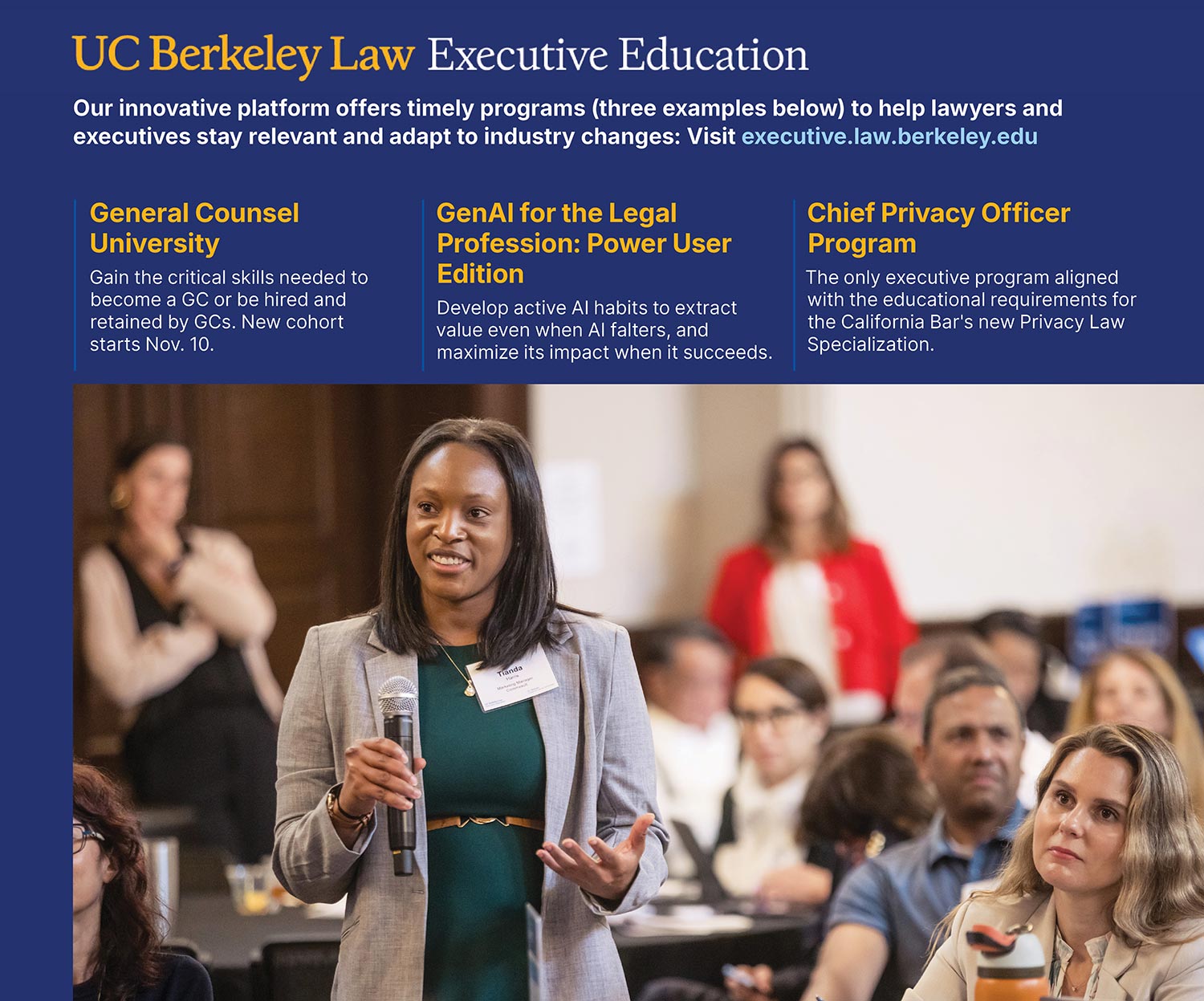
UC Berkeley Law Executive Education Advertisement
UC Berkeley Law logo
Thanks for reading our Fall 2026 issue!
